
The European Heritage Project by Peter Löw
  • About
    • THE INITIATOR
    • THE COMMITTEE
  • Strategy
    • RESTRUCTURING PLAN
    • THE CHARTER
  • Projects
    • The Projects
    • Project Overview
    • Chronology
  • Experience
  • News
  • EN
    • DE
    • FR
    • IT
  • Click to open the search input field Click to open the search input field Search
  • Menu Menu

Its historical use as a limonaia (lemonary) had been discontinued at San Sebastiano for several decades. Moreover, the property had been vacant for years and was in danger of falling into disrepair, a fate that it shares with many other limonaie.

Northeast of Limone sul Garda, directly on the lake, lies one of the world’s oldest limonaie, San Sebastiano. The complex dates back to the 13th century and represents an agricultural peculiarity to the Lake Garda region. Although the northern Garda Lake is already enclosed by the foothills of the Alps, Mediterranean lemons have been cultivated in this area for centuries. Monks from the nearby Franciscan monastery in Gargnano are said to have been the first to grow them here, bringing the Mediterranean fruit from Genoa to Lake Garda in the 13th century.

Near Limone sul Garda, the warmest region of the lake, the monks discovered a special microclimate that enabled economic cultivation of the fruit throughout the year. The technically complex, stone planting walls facing southwards collected the solar energy during the day and emitted it again during the night. Its historical use as a limonaia had been discontinued on S. Sebastiano for several decades.

MORE | LESS

The property acquired by The European Heritage Project had been vacant for years and destined for ruin, a fate it shares with many other limonaie. At the beginning of the 20th century, new means of transport made it cheaper to import lemons than to grow them, and lemon flavourings and vinegars were more frequently produced artificially. This form of agriculture, typical for the region, increasingly lost its importance, and almost all limonaie disappeared.

The European Heritage Project aims to save the entire estate as an agricultural production unit. In particular, a limonaia, which has significantly shaped the character of an entire region, is to be rebuilt in its traditional form. This is an attempt to revive a worldwide unique form of cultivation and to transfer it to the present day.

The European Heritage Project intends to revitalise the existing areas and resume lemon cultivation with subsequent individual projects. It intends to purchase additional agricultural land to increase the area under cultivation as well as the yield. The subsequent production of the traditional regional drink Limoncello from the local lemon cultivation is also planned.

Initially, however, the focus will be on urgent preservation measures to prevent further deterioration as well as the loss of historic substance. This will take place prior to the preparation of a status report, which will include a historical assessment.

PURCHASE SITUATION

The facility stood empty for years. It was owned by a 90-year-old Milanese lady who had originally used the property as a summer residence but had not occupied it for more than 10 years.
Only one part-time gardener took care of the grounds. After being contacted by local politicians, the European Heritage Project was able to acquire the property in 2019.

HISTORY

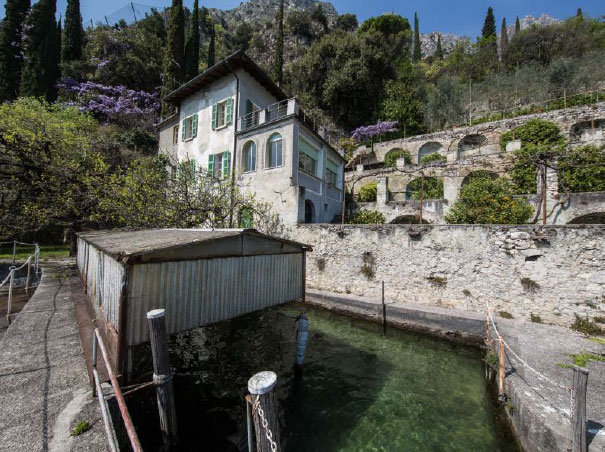
According to information from local sources, the site probably dates back to the 15th/16th century. The buildings on it, however, date to a much later time. The upper structures of the commercial and residential building to the west are more likely date back to the 19th century. The central building was probably erected in the early 20th century Art Deco period as a holiday building.
The actual production areas themselves however, date back to the 16th to 18th centuries, when lemon cultivation was still flourishing.
The entire area was probably used for purely agricultural purposes and administered from the nearby town, Limone. Towards the end of the 19th century, agricultural activities probably ceased here too and the property was used as a “summer resort”. The construction of a natural pool and a sandy beach with groynes (rigid structures that interrupt water flow), as well as modern buildings are evidence of this. This was accompanied by a conversion of the agricultural land. The lemons had to give way to more decorative horticulture. Today, aside from a few reminiscent lemon trees, the garden is dominated by palms, olive, fig and orange trees.

CURIOSITIES AND INTERESTING FACTS

A Hidden Chapter of the Limonaia – The Surprising Search for a Mysterious Car

In late summer 2025, an extraordinary coincidence led to one of the most exciting discoveries in the recent history of the Limonaia San Sebastiano. The architect and the curator were alerted by a hydraulic engineer working on the property to an encounter he had experienced during his August vacation on a cruise ship. Among thousands of passengers, he met the daughter of the former curator of our Limonaia – an almost unbelievable meeting that nevertheless formed the starting point of a surprising chain of events.
During their conversation, the woman asked him if “the car” had been found during the current renovations. When we followed up, she told us about an old family story that her father had often mentioned. According to him, a vehicle – a FIAT Balilla from the 1930s – was hidden behind a stone wall in the middle of the Limonaia. At that time, the model was closely associated with fascist propaganda and was therefore a politically charged symbol. At first, this idea seemed hardly realistic, as the supposed location lies far below the road and a hiking trail, seemingly inaccessible. Only a look at historical maps changed this assessment: In the 1930s, the coastal road did indeed run significantly lower. This suddenly made the story plausible and gave it a completely new dimension.
Why such a car might have been buried cannot be definitively determined today. However, the daughter reported that her father and other contemporary witnesses had repeatedly spoken of incriminating circumstances. Limone is located very close to Salò, the seat of the fascist government in the final years of the war. It is conceivable that the vehicle was hidden in this historical context – perhaps as an escape vehicle, perhaps to conceal compromising material before the arrival of the Allies. None of this can be proven, but the historical context makes various explanations seem possible.
Her recollections went even further. In the basement of the main house, there had been a secret room during her childhood, hidden behind a false wardrobe. She remembered an arsenal of weapons that had been located there. What happened to them afterward remained unclear. Within the family, there was speculation as to whether the weapons might have been buried in the woods or disposed of in the lake. There is no evidence for this either, but the accounts add to the picture of a turbulent and complex past for the property.
Another clue came from her husband, who had worked at the Limonaia as a young farmhand. He remembered small fires on the hillside that were accompanied by violent explosions. He suspected that ammunition or pieces of military equipment buried in the ground might have detonated. This observation lent the story an additional layer of authenticity that we could not ignore.
Given the multitude of clues—however improbable they initially seemed—we decided to investigate the matter systematically. We commissioned a specialized company to examine the relevant area of ​​the Limonaia using modern technology and to locate any potentially hidden structures or objects in the soil. Whether a vehicle, relics from wartime, or ultimately just a family legend lie buried in the ground remains to be seen. One thing is certain, however: the Limonaia San Sebastiano holds more history than previously thought, and the coming months will reveal what other secrets will come to light.

ARCHITECTURE

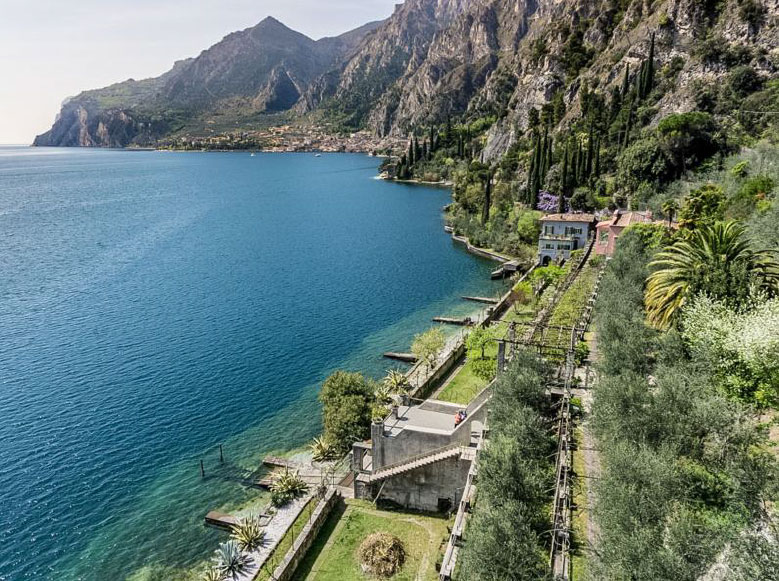
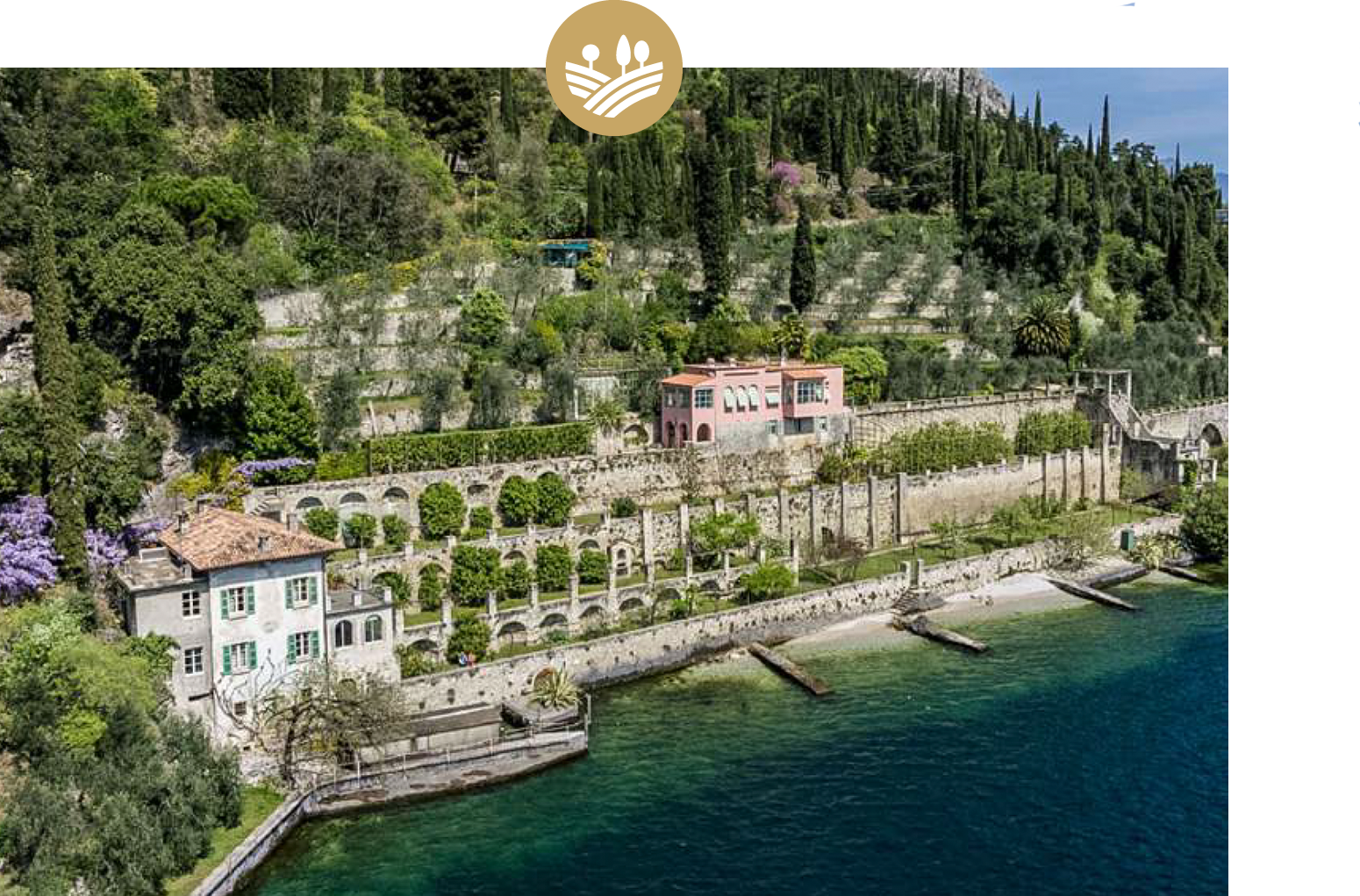
The entire site extends over approximately three hectares with an over 200 metre long shoreline. The property faces due south, which is fundamental for the operation of a limonaia (lemonary). Stone reflector walls, located on four to seven terraces, absorb the sun’s energy and release the heat during the night. The apsidal indentations, which concentrate the sun’s energy, are particularly noteworthy. In front of them, column-like fastening pylons for the historical heat protection elements still exist, which offer protection to the lemon groves, especially in the colder seasons. The heat protection elements themselves have not been preserved.
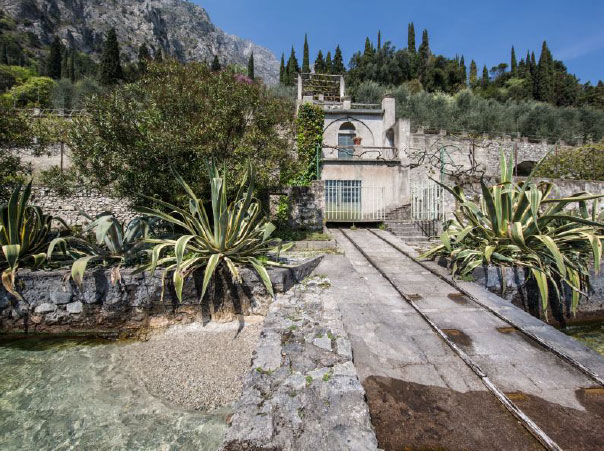
The terraces extend over more than 15,000 square metres. To the west they are accessed from a commercial and residential building, presumably built in the 19th century and in the centre there is another Art Deco style residential building, probably from the 1920s.
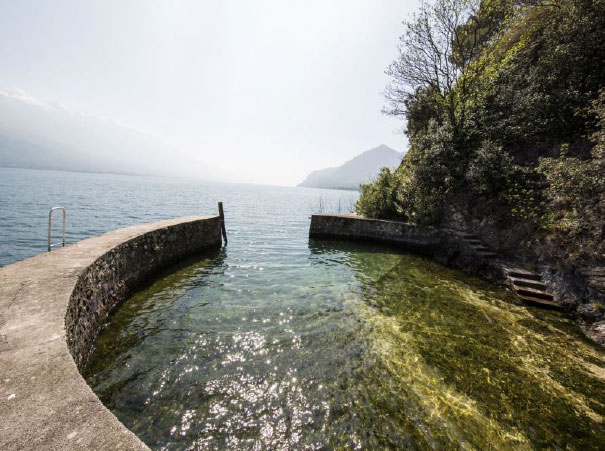
The terraces are connected by four parallel stone staircases that lead directly to the lake. The estate has its own harbour, as well as a so-called natural swimming pool, which allows sheltered bathing in the lake water. In front of the property on the lake side are groynes, which are intended to protect sand fill from being washed away and so affords the property its own sandy beach. Numerous caverns have been driven into the mountain, which may have been used to store the harvested fruit in bygone days but were lately used as winter storage for the farm’s own motorboats. The site is divided in the north by the Via Reamol, the historical connection to Limone in the south and Riva in the north which today is, however, only used as a less frequented bicycle and hiking path after the SS45 motorway came into operation.
All in all, the site is certainly one of the most important Limonaie on Lake Garda because of its location and seclusion.

STRUCTURAL CONDITION AT TIME OF ACQUISITION

Although the estate gave the impression of being abandoned and, as such neglected, the defects were significantly less than feared. The biggest drawback was that the historical thermal insulation systems were no longer available and only the fortification pylons tower into the sky like mute reminders, desolate and useless. There was a total lack of professional rigging options for the agricultural land. All sanitary facilities, electricity and heating were at pre-war levels.

RESTORATION AND CONSERVATION MEASUREMENTS

In cooperation with the authorities of the Bene Culturali (protection of historical monuments) and the responsible Sopraintendenza in Brescia (an arm of the Italian ministry of cultural heritage), the European Heritage Project is currently drawing up a Piano di Recupero, a restoration plan for the operation of a limonaia in the historical style. On this basis, both the buildings and the terraced cultivation areas are being renovated and rebuilt. In particular, the reconstruction of the thermal protection systems will give the entire facility back its historical appearance.
In the second step, agricultural operations will be restarted, i.e. lemon trees will be planted and cultivated. Special emphasis will be placed on the historical varieties. Attention will be paid to extensive historical cultivation that is sustainable and environmentally friendly, using local resources (water, sun).
In a third step, the estate will also be made accessible to the public. This should not only have a high appeal but will also support tourism efforts in the region by refocusing on its historical strengths.
It has not yet been decided whether a distillery will be built to produce the famous limoncello (lemon liqueur).

Previous Previous Previous Next Next Next
12345
Open image in lightbox: limonaia-san-sebastiano5 Open image in lightbox: limonaia-san-sebastiano5
Open image in lightbox: limonaia-san-sebastiano4 Open image in lightbox: limonaia-san-sebastiano4
Open image in lightbox: limonaia-san-sebastiano3 Open image in lightbox: limonaia-san-sebastiano3
Open image in lightbox: limonaia-san-sebastiano2 Open image in lightbox: limonaia-san-sebastiano2
Open image in lightbox: limonaia-san-sebastiano1 Open image in lightbox: limonaia-san-sebastiano1

Previous Previous Previous Next Next Next
123456789101112
Open image in lightbox: Palais-Sonnenhof Open image in lightbox: Palais-Sonnenhof
Open image in lightbox: Bergbauernhof Open image in lightbox: Bergbauernhof
Open image in lightbox: Schloss-Hofhegnenberg Open image in lightbox: Schloss-Hofhegnenberg
Open image in lightbox: Zur-kleinen-Dreifaltigkeit Open image in lightbox: Zur-kleinen-Dreifaltigkeit
Open image in lightbox: Vergeneogd Open image in lightbox: Vergeneogd
Open image in lightbox: Convento-di-Sezzate Open image in lightbox: Convento-di-Sezzate
Open image in lightbox: Malta Open image in lightbox: Malta
Open image in lightbox: Frankenberg Open image in lightbox: Frankenberg
Open image in lightbox: Palazzo-Tron-a-San-Beneto Open image in lightbox: Palazzo-Tron-a-San-Beneto
Open image in lightbox: Baden-Baden Open image in lightbox: Baden-Baden
City Ensemble Kitzbühel Open image in lightbox: City Ensemble Kitzbühel Open image in lightbox: City Ensemble Kitzbühel
Open image in lightbox: Lauffen Open image in lightbox: Lauffen


© Copyright - The European Heritage Project Protected as part of the UNESCO World Heritage
  • Link to Youtube
  • Imprint / Legals
  • Data Protection Policy
Scroll to top Scroll to top Scroll to top

We use cookies on this website. Some are essential, while some help personalise content, measure usage for us to provide a better and safer experience.

Accept cookiesPersonalise cookies

Cookie and Privacy Settings


How we use cookies

We may request cookies to be set on your device. We use cookies to let us know when you visit our websites, how you interact with us, to enrich your user experience, and to customize your relationship with our website.

Click on the different category headings to find out more. You can also change some of your preferences. Note that blocking some types of cookies may impact your experience on our websites and the services we are able to offer.

Essential Website Cookies

These cookies are strictly necessary to provide you with services available through our website and to use some of its features.

Because these cookies are strictly necessary to deliver the website, refusing them will have impact how our site functions. You always can block or delete cookies by changing your browser settings and force blocking all cookies on this website. But this will always prompt you to accept/refuse cookies when revisiting our site.

We fully respect if you want to refuse cookies but to avoid asking you again and again kindly allow us to store a cookie for that. You are free to opt out any time or opt in for other cookies to get a better experience. If you refuse cookies we will remove all set cookies in our domain.

We provide you with a list of stored cookies on your computer in our domain so you can check what we stored. Due to security reasons we are not able to show or modify cookies from other domains. You can check these in your browser security settings.

Other external services

We also use different external services like Google Webfonts, Google Maps, and external Video providers. Since these providers may collect personal data like your IP address we allow you to block them here. Please be aware that this might heavily reduce the functionality and appearance of our site. Changes will take effect once you reload the page.

Google Webfont Settings:

Google Map Settings:

Google reCaptcha Settings:

Vimeo and Youtube video embeds:

Privacy Policy

You can read about our cookies and privacy settings in detail on our Privacy Policy Page.

Data Protection Policy
Adapt cookiesReject all cookies